Featured

01110111 01100101 01101100 01100011 01101111 01101101 01100101=Welcome

This blog will be on the topic of artificial intelligence. It will focus on what is the subject of study, a variety of examples of it, its history, achievements, prospects for the future, its ambiguity and finally ethically applied to businesses. I want to inform the public about this subject because often people lack information when talking about this, it’s important to be up to date before providing an opinion. The main reason that I want people reading my blog is that A.I is slowly taking up in to our society and is important be aware of this that is taken such a great part in to the way we live, is far too late to eliminate or denied this phenomenon so learning how to use it ethically will ease our way into it .

Thanks again for visiting hope to see you every week, Jhon.

https://www.thetambellinigroup.com/artificial-intelligence-transforming-the-nature-of-work-learning-and-learning-to-work/

Fiction vs. Reality: AI in movies and series.

To understand the nature of certain phenomenon is always useful to analyse it from different perspectives. In this blog I have been sharing my input on artificial intelligence from a very research-wise and serious point of view, and today I will expose how this topic is seen in the field of art, specifically in films. These approach will try to closely observe how AI is seen by society and how these ideas expressed in different films and series are close to reality. Always have in mind: Reality often surpasses fiction.

1.SkyNet (Terminator)
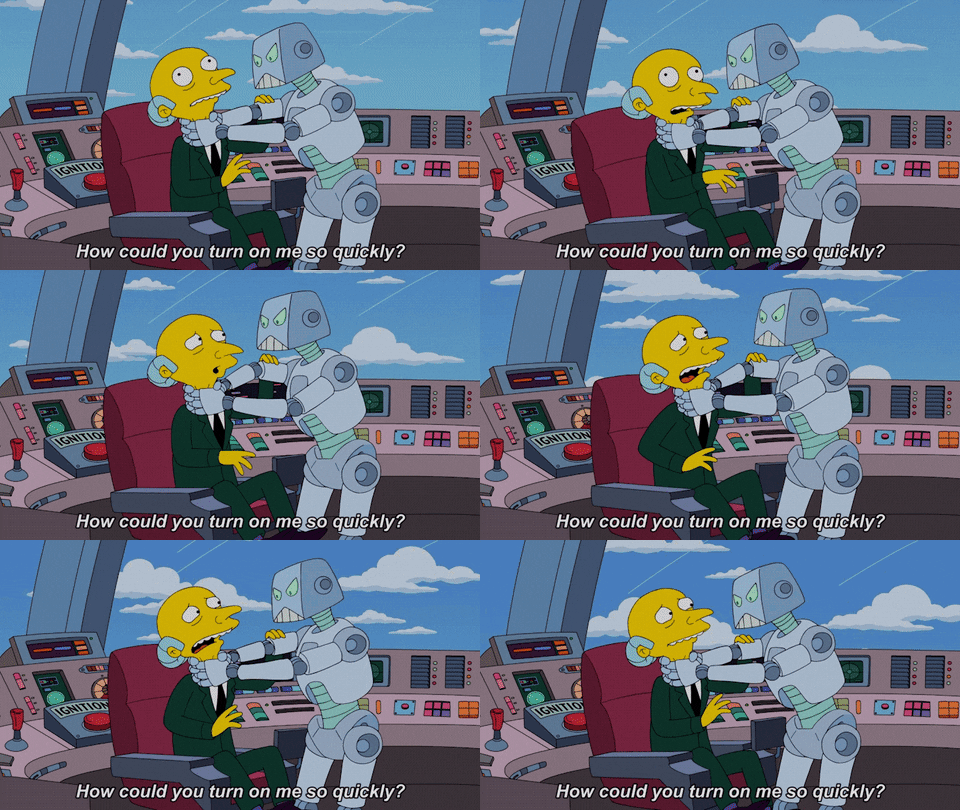
Elon Musk started a project called Neuralink to ‘avoid A.I. from becoming other’, said “There have been movies about this, you know, like Terminator. There are some scary outcomes. And we should try to make sure the outcomes are good, not bad.” To put this into perspective, in the movie, SkyNet is a superintelligence system that spread into millions of computer servers across the world. After this the system becomes self-aware of what surrounded it and of its true potential, which turned into a concern for the creators that materialize when they tried to deactivate it. But the system went into self-protection mode and actually became a threat for humanity since it began to try to exterminate everyone once and for all.

But this get worse: To prevent human error in any use of military hardware and nuclear weapon owned by the United States, the government decided to put The SkyNet system in charge of these properties. However, after deciding to end humanity, the SkyNet system goes about starting nuclear wars. And now to avoid having feeling-driven people, one of the most important and powerful countries in the world had completely the opposite in charge: a cold-hearted and Maquiavellian system.

It would be considered logical to ask ourselves, “Why wouldn’t a robot with no emotional impulse be safer than our egomaniac leaders?” well rest assure, mercy is between our emotional impulses, and is something that we want for someone who has to only press a button in order to kill us all.

2.I-Robot
During this movie we get to see Will Smith fighting robots which disobeyed command and took over everything and everyone. These robots were meant to serve humanity, and to obey the Three Laws of Robotics, which go as follows:

  • 1.A robot may not injure a human being or, through inaction, allow a human being to come to harm.
  • 2.A robot must obey the orders given it by human beings except where such orders would conflict with the First Law.
  • 3.A robot must protect its own existence as long as such protection does not conflict with the First or Second Laws.


Society, in fact, was entitled to a NS-5 robot per person to make their life a little bit more safe, fun and easy until the mother ship computer decided to command all other robots to disobey and turn against people

Is no secret that everyone will want a life like that, because actually everybody gets up in the morning in order to live a little better, and the idea of having robots fulfill that objective doesn’t sound as crazy, but we need to be careful because machines might as well want us for their benefit or start a revolution just like any honorable sentient. And even if governments implement regulations and rules, I mean come on: Revolution does not care about nothing that is written in any paper. And this movie show it to us.

3.Metalhead (Black Mirror, Season 4)
Based on the “Boston Dynamics videos crossed with the film All Is Lost”, the episode focused on the aftermath of the fall of humanity and the situation of a character called, “Bella” who desperately tries to run from a really, really scary robot. This whole idea and development is really exaggerated but the concept of these robot made to fight, jump, run, escape, fly and any other physical skill is actually a reality. For example, a portion of United Arab Emirates´ police is occupied by robots. And let’s face it, if an army of robot dogs (As shown in the episode) or any other type of army was developed for good, and either corrupted or altered for a darker purpose, what on earth could stop them? The real life prototypes have impressed everyone with their remarkable balance, speed, etc. But yet again, what if one of these prototypes is ordered to be against you? To injure you? To kill you? I may suppose is not as cool.

Danger itself is what describes the perspective of art and society over AI. What do you think about it?

Out of business: AI in the general work force

In the work force, the implementation of forms of A.I. is inevitable. Technical jobs or processes that are mainly described as, “patterns” like security procedures, getting into the office door, logging into computers, can all be developed, performed and well maintained by A.I.

Take tech company Three Square Market (32M). The majority of employees have had RFID implants injected between the thumb and forefinger. These implants serve for many functions that ease the staff work including password storage and personal security and access to facilities and tools without having that annoying keycard all the time. All these things, as little or minor as they appear, are in the big picture factors for the increase of speed and efficiency of people’s work. In the future, we will most likely get to see easier ways of paying, unlocking doors, using phones, boarding flights, all within our satisfactory reach. And while the idea is cool, and appears to be something that could improve our life-style, it also comes with a lot of grey areas.

These gray areas are all summed up into one word: Privacy. All these passwords, codes, keys, numbers, that you hold at your reach is indeed closer to you but at the reach of everyone else so the information could easily be taken out of you by forceful means, or used against you. It could be scanned or replicated, much like when you get sudden withdraws from your debit card or midnight credit purchases. But those two things take research and time meanwhile ripping your cellphone out of someone else´s hand is not as intellectually challenging

Furthermore, this privacy issue also looks into spying. We know that every-day-use hardware and software usage is traceable nowadays. Your internet usage, your phone, your car, you. And we always have those things with us, meaning that we are ever after susceptible to corporate tracking and surveillance every single minute of every single day.

It could be the absolute end of privacy. Employers could find you at any time of the day, Stalkers could eventually know your routine, and government will always know what you do in your beloved intimacy, a word which would most obviously disappear from dictionaries.

Moreover, besides its harm to privacy and information, AI is known for its possible responsibility over the loss of jobs, which number is staggering. According to a study compiled by McKinsey Global Institute, a worst case scenario of 800 million jobs worldwide could be lost to automation by 2030. In the US alone, between 39 and 73 million jobs are at threat of automation, which equates to around a third of the workforce.

Hopefully this situation of high scale automation will create new jobs and refine existing roles. Workers will also be able to switch careers, thing that is not absolutely feasible or encouraged and if done, will create a total chaos in the job market since some jobs will be drowned by demand meanwhile others choke to death by lack of it. It is predicted that only the individuals in higher income jobs will be more able to adapt to the changing market, while demand for the middle and low-skill occupations will decline.

So how do millions live without a job? Should we adapt? Should we fight against it? Share your opinions and stay tuned.


Irreplaceable?

As I have said before, artificial intelligence is a great opportunity for the improvement of human life. But the potential of this technology also represents a threat for our jobs and professional development because it just might surpass our capabilities until the point in which they are suitable to replace us in the work place. This thesis is considered unproven by some, and completely belivable by others. But to put it into perspective, I will then expose some of the roles that are being often occupied by artificial intelligence (and which can be soon fully occupied if technology keeps to improve).

  1. Finance Analyst
    A recent Ohio University infographic presents AI’s handling of financial analytics in the near future. This prediction was made by taking into account programs capable of financing activities such as Google Analytics, which are able to read monetary results and relate them to specific and proper business decisions that aim to a firm’s profitability. We may live long enough to see AI having a unique, in depth understanding of individual financial crises, replacing human beings in crucial steps to monetary redemption. Bad news for financial analysts.
  2. Help Desk
    AI is already being used in online help centers. If you have any doubts about a product or service offered, you may have the chance to act direct questions into a chat or an exchange-voice system (which is similar to a call) and have an answer or a solution. However, this programs are tied to a protocol and a rather basic way of interacting so if the question or problem exposed is really specific and/or unique, you may end up calling to a branch and communicating with a real human being. In despite of all, technology is always improving and this is a sign of a possible total replacement of humans.
    .
  3. Market Research
    Marketing is one of the most notable field for Artificial Intelligence occupancy. With the data of previous consumer trends, the results of marketing campaigns, and the actual figures of demand for similar past products, AI may have the key of deciding the next most effective marketing strategy. AI’s ability to learn and lack of human fatigue may give it a better data-based assumption and in an ongoing basis. But what defines the danger of this is the salary expense of businesses: An employee will always have the guts to ignore a number if he or she feels that other action is the proper choice to maximize earnings, but paying these great minds is expensive and the spend-to-earnings ratio ends up being favorable for exact AI rather than for creative humans.
  4. Trend Prediction
    This would be some kind of fantasy for any company, but there is a chance of not wasting a research budged and actually predict a trend in your market of interest. Trend analysis leads to trend prediction with AI, perfect input for perfect output with no inconvenient. All data is compiled at once and analyzed when wanted to ultimately provide users the most logical solution.

So, now you can take your own posture on the subject and act upon it. Personally, I think this situation will be problematic but technology advances must be encouraged for greater goods. For now, we may show to the job market how our human faculties are just irreplaceable.

Reality or just fantasy?

A.I and its advancements are promising potential changes to the everyday situation of corporations, individuals, and whole societies. While much of this technology is growing at a slow rate at the moment, sophisticated A.I is on the way and here are four of the many ways in which it will affect us in the future.

  1. Automated Transportation
    With the existence of self-driving cars, we have received a promising forecast for the future improvements of automated transportation. Even though today there is still laws that require this self-driving car to have a driver into the automobile, public acceptance has been growing and the U.S. department of transportation released definitions of different levels of automation, being for example the Google’s test car classified as first level. Further levels involve buses and trains, which are closer to full automation in various cities of the world.
  2. Cyborg Technology
    This deals with what we know as sci-fi. If you have seen any cyberpunk-type movies such as ghost in the shell, you know what do I mean by “enhancements”, which are those improvements to our own natural abilities in order to get rid of any limitation. Yoky Matsuka of Nest believes that AI will become useful for people with amputated limbs, as the brain will be able to communicate with a robotic limb to give the patient more control. This kind of cyborg technology would significantly reduce the limitations that amputees deal with on a daily basis.
  3. Taking over dangerous jobs
    Drones are now being used to be part of those jobs that represent a real threat to human life as the physical counterpart for defusing bombs, but it requires a human to control them, thing that make this tool something a bit far from a robot of AI but whatever their classification, they have saved thousands of lives. As technology improves, we will see more AI integration to help these machines function in any job involving toxic substances, intense heat, and ear-splitting noise, etc. Robot Worx explains that robotic welding cells are already in use, and have safety features in place to help prevent human workers from fumes and other bodily harm.
  4. Improved elder care
    For many seniors have to rely on family members or even hired people to be taken care of, because surviving on their own is harder every day. A.I is at a stage where replacing this need isn’t too far off, says Matthew Taylor, computer scientist at Washington State University. “Home” robots could help seniors every day and for the rest of their lives with only set-up costs and none of those inconvenients that rise when one hire someone to take care of an elder. And even without knowing for a fact the next achievements of A.I in this field, sure is promising economically and socially wise.
  5. Achievements of this technology in general will help us as individuals, society and corporate community, because dangerous or unpractical situations in which humans are involved in will be eliminated out of our way to efficiency.

For starters.

Artificial Intelligence has been studied for decades and is still one of the most elusive subjects in Computer Science, and nowadays in politics and society. This partly because of how large and potent the subject is, potent to do good but yet potent to do badly. AI ranges from machines that can think independently of thinking to algorithms used to play board games. It has applications in nearly every way we use computers in society.
The term artificial intelligence was first mentioned by John McCarthy in 1956 when he held the first academic conference on the subject. But the journey to understand if machines can truly think began much before that. In Vannevar Bush’s seminal work As We May Think he proposed a system which amplifies people’s own knowledge and understanding. Alan Turing gave his own input by writing a paper on the notion of machines being able to simulate human beings and the ability to do intelligent things, such as play Chess. And from those days to now, one can refute a computer’s ability to process logic. But some do debate whether if a machine can think. For example, there is the so-called ‘Chinese room’ argument. Imagine someone is locked in a room, where they were passed notes in Chinese. Using an entire library of rules and look-up tables they would be able to produce valid responses in Chinese, but would they really ‘understand’ the language? The argument is that computers can apply logic to fulfill objective but without really understanding the activity of its purpose, which is in essence of what we know as “thinking”
Themes of AI
What most people think of as ‘true AI’ hasn’t experienced rapid progress over the decades. Significant AI breakthroughs have been promised for the past 60 years, but nothing close to those situations that come close to the movies that have scared us so much and make us skeptical about AI. Rather than that, the main advances have been advances in search algorithms, machine learning algorithms, and integrating statistical analysis into understanding the world at large, what is largely used in examining purchase histories and developing marketing strategies and decisions.
In the field of AI expectations seem to always outpace the reality. After decades of research, no computer has come close to passing the Turing Test (a model for measuring ‘intelligence’) which is ultimately what determines the how transcendental and dangerous is a AI. The logical power of systems have grown but have not become as common as human experts. And while we’ve built software that can beat humans at some games, open ended games that require maliciousness, team work and hunches are still far from the mastery of computers. For now, we are focusing more on what can sell or attract media and people, or on what makes cyclical processes and patterns more quick and easy, but not on what may be powerful enough to… We will see it next week.